
Dental Implants
Affordable Dental Implants Can Change Your Lifestyle
Just ask 62 year old Estelle Ceuninck from Fraser. "I had struggled for years with a set of upper and lower dentures unable to chew the foods I desired. I couldn't even drink a glass of water without my lower denture unseating itself. I was also self conscious of the poor smile that I had so I found myself smiling less with nowhere to turn. Now, after an excellent new upper denture and just two implants supporting my unique lower denture, my lifestyle has totally changed. I am more confident in my smile and I can now eat and function with my teeth as though they were my own. Indeed my lifestyle has changed immensely. This procedure was well worth the time and effort and I found it to be uniquely affordable as well."Dental implants are a modern day miracle for people needing replacement of diseased, hopeless or missing teeth. Those teeth can now be replaced with strong, natural looking teeth that even your closest friends and family will not be able to detect them up close. Imagine replacing a missing tooth with an implant retained natural looking tooth that will never decay and be there for life.
The loss of teeth can be very devastating for people who take pride in their appearance and smile. A confident smile is lost quickly when teeth are missing or when partial or full dentures look artificial. A smile is an important part of everyday life from having a high self-esteem to making a great first and lasting impression.
There are three main goals when treating people with missing teeth, whether you have one missing tooth or do not have any remaining teeth. The first goal is to improve function so that a high level of comfort is achieved during rest and while eating. The second goal is to achieve a smile that you will be confident; a smile that is very natural. The third goal is to improve your overall health, as today modern dentistry is showing so many correlations between dental health and systemic disease.
If you think that you may be a candidate for dental implants whether you have one missing tooth or are currently wearing dentures, I hope that you find the following information helpful to you or someone you know.
What happens when you lose teeth?
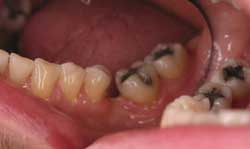 When teeth are present in the jaw bone, chewing creates stress in the bone. Like physical exercise places stress on your muscles keeping them strong, chewing does the same by placing stress on the teeth and ultimately on your jaw bone. When a tooth is lost, the bone is not exercised and it is unneeded, so your bone becomes weak and is lost. Moreover, teeth will shift into the area of the missing tooth. After a period of time, the teeth behind the missing tooth will drift and fall forward. There is a point when the teeth are tipped so far forward that it becomes very difficult to restore without extracting the leaning teeth. This can also disrupt your bite causing jaw pain, cheek biting, and premature wear on your teeth. The picture below shows what happens when a missing tooth is not replaced.
People who are missing all of their teeth will lose bone continually until the jaw bone is very thin and fragile. Over time, a denture will sink into the bone in the chewing areas, which leaves a ditching under the denture for food to collect. At this point, a denture cannot be stabilized and is very uncomfortable to function with. Even areas where a single tooth is lost will loose bone. The bone in those areas can become very thin quickly depending on the area. This is why it is important and the standard of care to place bone grafts in socket sites where teeth are extracted. The bone grafts prevent the bone from essentially folding in and causing the bone to become thin. Keeping the bone thick allows for successful implant placement.
Bone loss is a very slow and predictable process, but it can be prevented with the help of dental implants. Dental implants will exercise the bone to keep it strong and rigid. They will also prevent areas of bone from ditching under a denture. If you do not have enough bone for implant placement, you can have bone added to your jaw to give you adequate width and height of bone for implant placement. This ultimately will stop the bone loss from occurring.
What is a dental implant?
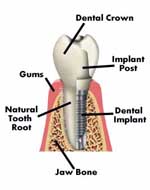 A dental implant is essentially a special screw in the shape of a tooth root that is placed into your bone. Implants are made from medical grade titanium and often times are coated with synthetic bone. The top of the implant will be at the level of your gums so that you will not see any part of the screw. The implant then goes through a healing period. During this healing period, the implant fuses to the bone to become part of the dentition.
Implants will never decay and have a 30+ year prognosis with 100% success rate in our practice. They also do not require modifying the teeth adjacent to the implant. Implants are very esthetic because they are able to hold your bone, keeping your gums at a natural height. Another advantage is that partial and full dentures can be attached to the implants which keep dentures tightly secured for improved function and cosmetics. Overall, dental implants are very predictable and can greatly improve a person's way of life.
Click on dental implant restorations link above to learn about crowns, bridges & dentures attached to dental implants.


- Address: 38951 Ryan Rd | Sterling Hts, MI 48310
- Phone: (586) 978-8233
- Fax: (586) 978-8516

Jostock Dental offers bright smiles with comprehensive dental work, teeth whitening, veneers, dental implants, cosmetic dentistry, family dentistry, and emergency dental care. Dentists in Metro Detroit | Oakland County | Macomb | Sterling Heights
